


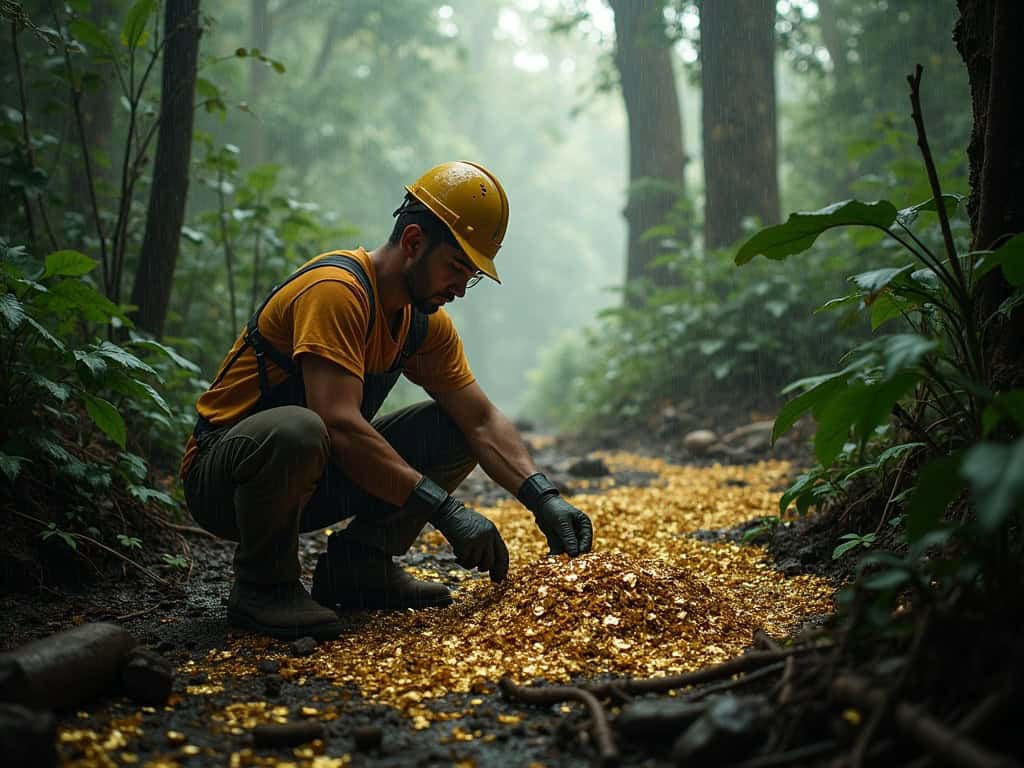
What’s Wrong With Gold?
Over eighty percent of all gold that is dug out of the ground ends up as jewelry. Industry boosters claim that it is an essential metal but in fact it is almost entirely cosmetic. Those few industrial purposes for which gold’s characteristics are required could be provided for through the recycling of gold coins and bars.
This fact, that gold is non-essential, sets the tone of the tragedy that is the global gold rush, led by companies like Newmont and Freeport McMoRan. This current boom is on a scale unimagined in bygone days. For every ton of gold the U.S. industry produces today it also generates three million tons of waste rock. On a personal scale, an average pair of wedding bands could make a 6-foot wide, 6-foot deep, 10-foot long pile of tailings in the happy couple’s backyard.
South Africa is the world’s leading producer; in 1997 it produced 494 tons of gold. For all the riches the industry represents in South Africa, every 1.86 tons of gold mined costs one life and 11.3 serious injuries through accidents. North America, particularly the western states of the United States, is still a substantial producer of gold. In one state alone, Nevada, the gold industry will leave three dozen huge open pits given their current operations. Each pit may be as much as three miles long, one mile wide and half a mile deep, and contain lakes that pose acid pollution problems.
Brazil is the biggest single small-scale gold producer, with annual production of 80 tons. Some 500,000 gold miners work in the Amazon region alone extracting gold by dissolving ore in toxic mercury. Tests in several mining communities in Brazil found that more than 30% of miners examined had mercury levels above the World Health Organization’s tolerable limit.
In Africa it is less well-known what the condition and impacts of small-scale miners are, although they produce approximately 20% of Africa’s gold. In the sub-Saharan region more than 1.5 million people work in the informal mining sector, while in Zimbabwe that figure is about 100,000. Here too the use of mercury is prevalent as a means to chemical extraction of the gold.
What Drives The Gold Industry?
The gold mining boom has not been spurred by a jump in prices, but is manufactured by the integrated ‘mining-to-marketing’ nature of the gold industry. The price of gold has been relatively stable at between US$350 to $400 per troy ounce for the last decade. In fact since January 1997 gold has been at its lowest price for three years at roughly US$300 an ounce. Expansion is driven by growing speculation, new exploitation technologies as well as some new markets.
The main motors behind the gold industry are a handful of multinationals who heavily promote jewelry consumption. Indeed concentration of power in this industry is staggering. In 1991, just over 20 companies delivered more than 66% of official global gold production outside of China. The world’s two biggest mining companies RTZ-CRA and Anglo-American controlled nearly half this amount. In the last five years the concentration has become more extreme ‘with a rush of acquisitions and ill-tempered spats’ according to the Financial Times. Three companies in North America control 66% of the total market capital there : Barrick, Newmont and Placer Dome.
Demand for gold remains strong so long as middle-classes convert their affluence into the wearing of jewelry, a phenomenon the gold industry is banking on continuing. Asia is buying 70% of all new gold with India being the most important gold market in the world because there are now 150 million middle class people there with a disposable income. China is also a substantial and growing market.
A Legacy Of Poison
All mining has historically caused major environmental problems. One of the biggest problems is the fact that metals like gold are found in sulphide ores which when exposed to air become acidic. This in turn becomes sulphuric acid when brought into contact with water, a common enough ocurrence in areas with underground water supplies, dissolving toxic heavy metals like arsenic, copper and iron. This phenomonen is known as “acid mine drainage” and is harmful to animal, bird and plant life. Old mines, in particular, where shafts were sunk deep into the water table without any thought of future problems, often end up contaminating groundwater permanently.
Levels of copper as low as two parts of per million are considered lethal to humans while concentrations as low as five parts per billion can inhibit fish reproduction, which means that the fish population might dwindle over a period of years. Copper and sulfates concentrations exceeding one part per million can cause stomach and intestinal problems and kill animals like horses. Lead and mercury can kill humans and also cause stomach problems.
Cyanide: More Profits and More Poisons
In the last three decades gold miners have compounded this toxic impact with a new and additional problem — a technology called cyanide leaching which involves pouring sodium cyanide solution over large piles of crushed rock (heap-leaching), abandoned dumps of pulverised ore that has once been sifted for gold (dump-leaching) or in large containers (vat-leaching) to extract the gold through simple chemical combination. The problem with this is the leftover cyanide, which can be re-used, but is more often stored in a pond behind a dam or even dumped directly into a local river.
Invented in 1887 in Scotland, cyanide leaching was first used at Witwatersrand in South Africa, but it was perfected in the 1960s by the U.S. Bureau of Mines and first commercialized by Newmont Corporation in the United States. This technology can extract over 99% of gold from an ore allowing miners to obtain gold flakes too small for the eye to see. It also means that the miners can extract gold from the waste left behind from old operations which sometimes left as much as a third of the gold behind.
Popular concern over this technique has focussed on the lethal impact of cyanide. A teaspoonful of two-percent solution of cyanide can kill a human adult. Cyanide blocks the absorption of oxygen by cells, causing the victim to effectively “suffocate.” Mining companies insist that cyanide breaks down when exposed to sunlight and oxygen which render it harmless. They also point to scientific studies that show that cyanide swallowed by fish will not “bio-accumulate,” which means it does not pose a risk to anyone who eats the fish. In practice cyanide solution that seeps into the ground will not break down because of the absence of sunlight. If the cyanide solution is very acidic, it could turn into cyanide gas, which is toxic to fish. On the other hand, if the solution is alkaline the cyanide does not break down.
Mining advocates insist there have been no reported cases of human death from cyanide spills but scientists and activists argue that wastes derived from the cyanide leaching process will affect fish and livestock. “The attitude (is) if you don’t see corpses, everything is okay. There is good reason to suspect that a compound as aggressive as cyanide in lethal doses also has serious health effects in long-term chronic exposures at low levels,” writes Philip Hocker, president of the Washington-based Mineral Policy Centre, in a paper entitled “Heaps of Gold, Pools of Poison.”
Cyanide-laced mining waste killed 10,000 trout at the Richmond mine in the Black Hills of South Dakota while 900 birds were killed when they drank water at an Echo Bay mine in Nevada in 1989 and 1990. And over 11,000 fish were killed along an 80-kilometre stretch of the Lynches River by a cyanide spill from the Brewer gold mine in South Carolina in 1990, although it’s true that the heavy metals that may have been present in the waste may have been potentially more dangerous that the cyanide.
The Coming Plague
The gold mining industry looks set to spread like a plague, even though current production is higher than ever, because demand for the metal outstretched supply by 40% in 1996. Gold fever is quite literally sweeping the globe, with production jumping 50% since 1980 and expected to increase by a further 15% before the turn of the century. In 1995, 3, 642 tons of the stuff were mined globally.
Most of the new gold is coming out of so-called developing countries including Argentina, Ghana, Guyana, Indonesia, Peru and Tanzania with less stringent ‘waste minimization’ requirements than the U.S. Old mining countries have also stepped up exploration and exploitation plans – Australia’s production grew nine fold since 1980 and will rise another 40% by 1999.
In fact in 1995-96, over half of all exploration dollars in the entire mining industry was for gold, not for important minerals such as iron ore or bauxite. Disturbingly one out of five of these gold prospects was on indigenous territory or lands claimed by indigenous peoples. Within twenty years, with the decommissioning of many major existing mines, half of the gold produced is projected to come out of the lands of indigenous peoples.
In 1849 the California Gold Rush resulted in a genocide of its native peoplew while today Freeport McMoRan, operators of the world’s largest gold mine, have devastated five different indigenous groups on the western half of the island of New Guinea. The gold mining boom will set the stage for increased community dislocation, cultural erosion and environmental degradation in other communities.
Risky Business: The Grasberg Gold Mine
An Independent Annual Report on P.T. Freeport Indonesia, 1998
Introduction
PT Freeport Indonesia likes to portray the Grasberg mine as the greatest asset that a company could wish for and that it is safe as a bank. Unfortunately for investors and other stakeholders there is much evidence to the contrary. This report explains what the problems surrounding Grasberg are, and some of the steps that might be taken to improve the situation at this, the world’s largest open-cut gold and copper mine in the easternmost province of Indonesia.
Grasberg is known to different audiences as different things. For some it is Indonesia’s largest source of tax revenue2, for others it is a symbol of that nation’s corruption and cronyism. For the engineers it is a technological marvel3; for activists it is the locus of human rights abuse and destruction of the important local ecosystem in Irian Jaya. For the traditional owners it was the sacred head of their mother; for shareholders it is simply a bad investment4.
Wherever you stand, important facts about the mine are not disclosed by the company pertaining to future risks facing the operation. This report changes that by exposing some of the liabilities facing PT Freeport Indonesia (hereafter simply referred to as PT Freeport), and its parent companies Freeport McMoRan Copper & Gold and RioTinto. In particular:
• a pattern of human rights violations around Grasberg that has resulted in ongoing litigation against the parent company, Freeport McMoRan (page 9)
• the involvement of PT Freeport Indonesia staff in the death of local people, as recently as September 1997 (page 4)
• the destruction of local water quality, and pollution of the environment, as assessed by an independent consultant (page 15)
• the long-term environmental threats posed by the mining activity (page 17)
• the potentially illegal exploration inside the neighboring National Park (page 19)
• the poor track record that the partners in PT Freeport Indonesia bring to the operation (page 22)
• Freeport McMoRan’s corporate culture, established by the men at the top, which obstructs real solutions to these problems (page 20)
The tone for the corporate tragedy is set by PT Freeport’s complicity in the murder of hundreds of the local indigenous peoples, and the destruction of hundreds of hectares of rainforest. It is our conclusion that the risks stem from two decades of arrogance towards the local community, a lack of due care in environmental management, and a closeness to the dictatorship of Indonesia which, while once a business advantage, can now only serve to weaken the company’s standing.
Take the current political instability in the country. This massive nation is so close to political breakdown and economic collapse that the United States Embassy has contingency plans for a full withdrawal of its personnel and foreign citizens5. PT Freeport Indonesia—the Suharto family and regime’s biggest pet piggy bank—is in the midst of this crisis.
An array of threats face it in the scenarios for a post-Suharto Indonesia not least the fact that a very influential figure on the opposition, Amien Rais, has said that the government should “stop Freeport mining” and received much support for this stance. This leader of Muhammadiyah, the largest Muslim organisation in the country, feels Grasberg breaches Article 33 of the Constitution which stipulates that the earth, water and other natural resources shall be used for the greatest welfare of the people of Indonesia. He says the contract with PT Freeport Indonesia only benefits foreign investors6.
Yet PT Freeport Indonesia has no political risk insurance7 against risks such as nationalization. How could this be? Unfortunately for shareholders two good policies with the World Bank’s Multilateral Investment Guarantee Agency (MIGA) and the US Government’s Overseas Private Investment Corporation (OPIC) were canceled by the parent company in the last two years.
This was for one of two reasons. Freeport McMoRan Copper & Gold’s version is that it no longer requires insurance “against political risks such as civil wars or nationalization”8 as the staff told MIGA. The unofficial version is that the insurance was canceled to avert the scrutiny and conditions that the Bank and US Government had required in return for their guarantee9. It is no secret that the company terminated its contract on the eve of an investigation into the mine by the Multilateral Investment Guarantee Agency10.
In either case the cancellation of these guarantees appears to be a major problem now with Indonesia on the brink of chaos. And they both stem from regrettable and avoidable management decisions about this resource development project. Such has been the pattern.
Take another example concerning the better known threat of civil unrest around the mine.
At last year’s Freeport McMoRan Copper & Gold shareholders’ meeting a compensation fund was proffered by management as the way to resolve the social problems at Grasberg which Vice President Paul Murphy admits keep him up at night11. The proposed solution was known as the 1% Trust Fund because it put a paltry one percent of future profits to local development. Just this March a review12 for the company of its silver bullet to the crisis, found it to be a failure:
“The large sums of money which were intended as an effort to resolve existing social problems have on the contrary become a new source of difficulties and conflict. The general aim of giving these funds has not been attained.”13 This kind of exercise can only hurt the investor—not simply in terms of money wasted but in the reputation the company has built locally and globally.
Despite the lack of careful management and positive community relations by PT Freeport, people around the mine remain committed to upholding their rights and working out solutions with the company. That this has resulted in them going to the courts in the United States to seek redress for historical abuses is as much a measure of the company’s intransigence as it is a symbol of their resistance to being taken for granted and having their culture and homeland destroyed.
At base the parent companies controlling PT Freeport Indonesia need to work with the Amungme, represented by LEMASA (the Amungme Tribal Council), and other community groups to develop a plan for equitable benefit sharing from Grasberg. Prior, informed consultation and consent is a necessary condition for any future development at Grasberg, including the proposed expansion to triple production.
The way in which the company seeks community input is important in judging the validity of the process. As long as PT Freeport continues to attempt to buy community support with trinkets and beads, the Amungme and other communities are not being consulted—they are being bought. Only by establishing a process which recognizes that mine expansion is only an option, not a given, and that the local communities have the right to say NO to such development can there be true dialogue. Hiding behind the barrel of a gun held by soldiers won’t help either.
Top Ten Risks for Investors in PT Freeport Indonesia
Financial Risks
1. Worst performing stock in 1997.
Business Week placed Freeport McMoRan Copper and Gold, Grasberg’s grand-daddy, lowest in the Standard & Poor’s 500 index for 1997 with a 53.9 percent decline in share price. USA Today ranked Freeport McMoRan’s stock the fifth worst for 1997 because stock was worth 49.6 percent less than a year before. By comparison the Standard & Poor’s 500 index as a whole rose by 27.8 percent. The company has lost something in the region of three billion dollars in market capitalisation in the midst of this bull market.
2. Copper and Gold Prices Plunge
PT Freeport’s future is completely dependent on the price of copper and gold. Gold prices plunged heavily from close to US$400 a troy ounce in 1996 following market jitters over central bank gold sales. The price fell below US$300 an ounce last November, a 12.5-year low, while copper prices hit a three year low from US$1.25 a pound in 1995 to 93 cents in late 1997. The Asian economic crisis is expected to significantly curtail demand for copper, keeping the price low for the foreseeable future.
3. CEO Compensation
Executive compensation at Freeport McMoRan is indicative of the misguided priorities in the corporation. Moffett’s pay was more than 33 times greater than his nearest competitor in the gold industry, Ronald Cambre of Newmont, whose company raked up a 42 percent sales increase last year versus Freeport’s five percent. Moffett has consistently been ranked as overpaid since 1990 by Graef Crystal, the corporate compensation expert. Meanwhile his company consistently underperforms – from the bottomline to the higher moral ground.
Security Risks
4. Local Riots
In both 1996 and 1997, riots in Timika were sparked off by confrontations between Freeport and military personnel and local people. A number of people were killed in each incident, and Freeport’s vehicles, equipment and laboratories were smashed by angry crowds. Not only do these threats cost money and cause work to be stopped or slowed they illuminate the bigger risk of the Indonesian military enforcing a protection racket on the company.
5. Security: Response or Racket?
Observors have speculated that much of the violence in the Timika area is military-induced and enacted. This is perceived as a warning to PT Freeport not to try to reduce their dependence on the military or withhold payments made to them. Lesser stories of a standover abound – like the unloading of PT Freeport’s warehouse supplies by soldiers in Tembagapura or the commandeering of company helicopters to which the company turns a blind eye. The risk that this entails is obvious – ranges from the company losing complete control at the mine to getting bad publicity due to the ongoing violent actions by security.
6. Indonesian Instability
Indonesia is undergoing its greatest political and economic crisis since Suharto took power in 1965. Many observers believe Suharto will have to leave office very soon, if he does not die before he is forced out. PT Freeport’s future is tied to that of the dictator. Potential leaders of a post-Suharto Indonesia, including Amien Rias, have already spoken out about the favoritism this company has received due to its links to the Suharto’s companies.
Environmental Risks
7. Mining Waste
Freeport expects to dump three billion tons of waste rock in local alpine valleys, and as much as 285,000 tons of potentially toxic mining waste into local rivers every day. The conservative estimate of the impact of this disposal is the destruction of 130 square kilometers of lowland rainforest and a 1500 feet deep crater. The longer the company fails to implement standard environmental management procedures the greater the liability they create for themselves and the downstream communities. The proposed expansion of Grasberg will only exacerbate these impacts, as will any new mines in the Lorentz National Park
8. Acid Mine Drainage (AMD)
The potential health and environmental effects of the acid drainage from the three billion tons of waste rock and tailings are unprecedented anywhere on the planet. According to the company’s audit, AMD has already been detected feeding into streams around the mine site. Once the neutralization potential of surrounding limestone is used up the mine will leach thousands of tons of highly toxic heavy metals into local water systems. The longer the company mines the area the more likely it will see the effects of AMD and be held responsible. PT Freeport’s bonding and post-mine closure plans are inadequate to deal with this problem.
Legal Risks
9. Freedom of Information
Under the Freedom of Information Act (FOIA) two journalists petitioned the US Federal Government to release the data used by OPIC to determine that the Grasberg mine was destroying tropical forests. Freeport McMoRan and an unwilling OPIC have waged a two year, $100,000 lawsuit against them to keep this material from seeing the light of day. If it gets out, which most precedents under FoIA suggest it should, the public will have access to environmental studies, photographs and files showing just how badly managed Grasberg really is. This is sure to provide more ammunition for more lawsuits.
10. Litigation
On April 15th the state of Louisiana Court of Appeals re-affirmed Yosefa Alomang’s right to sue the company in this jurisdiction for human rights abuses. There are no more hurdles to the plaintiffs’ lawyers now bringing Freeport McMoRan into a full disclosure process, in which any past mismanagement may be revealed. This could include the environmental data the company has suppressed (above). CEO Moffett and other officers will be required to make depositions under oath in response to the claims against Freeport McMoRan and the legal discovery process will unearth company correspondence as this class action lawsuit goes to a jury trial.


