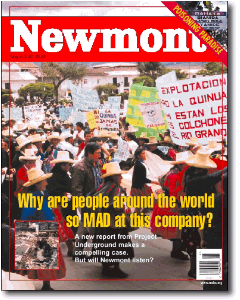
 Why are people around the world so MAD at this company?
An Independent Annual Report from Project Underground
Introduction
Why All The Fuss? Why are people all over the world mad about this company’s holes in the ground?
Newmont Corporation is the world’s second largest gold producer. As it extracts gold from the earth for profit, it ignores the costs that its operations exact on indigenous communities, the environ-ment and its own shareholders. This report will examine the impacts of Newmont’s mines in various parts of the world, and will look at the liabilities that its activities incur for investors from the point of view of other stakeholders.
The global gold industry today should be taking a long, hard look at its business. It has seen a very rough couple of years financially, as the price of gold has fol-lowed its naturally decreasing price curve to a low point exacerbated by central bank sales and promises of those sales. Mines are shutting down, transitioning to closure and suspending operations all over the world, including the Newmont-owned Mesquite mine in California. It is not only the low price of gold, but also the fact that companies increasingly have to exploit lower grade ores at higher costs that ensures that profits for the industry and its shareholders are decreasing. This does not make gold the safe investment and enduring collateral that it is continu-ally portrayed as by the industry.
This report looks at Newmont’s opera-tions or claims in five parts of the world, and challenges the rosy picture that the company paints of its interactions with local communities and its environmental reclamation projects. Those five regions are: Peru, Indonesia, California, Nevada and the Philippines. In all of these areas indigenous people are affected, and their cultures threatened.
In Peru—the indigenous people of the Northern Andes have seen their land dug up for Latin America’s biggest gold mine, and have suffered the pollution and loss of their water sources. Traditional cultural practices are being lost as people are forced to move from their communities to the city of Cajamarca.
In Indonesia—coastal communities on Sulawesi and Sumbawa can no longer eat the fish that were once their livelihood as the only fish they can find these days are contaminated. They are also suffering from a variety of skin diseases and dislocation due to the destruction of their subsistance lifestyle to make way for the mine.
In California—the Quechan Nation has endured the destruction of a section of the Chocolate Mountain range, an area that is sacred and irreplaceable to the Quechan people. Meanwhile the protected desert tortoise is being threatened by the mine.
In Nevada—Newe Sogobia, the land of the Western Shoshone people has been ravaged by dozens of pits which leach cyanide, ammonia and fluoride into ground waters while they also suffer the loss of water, wildlife, flora and sacred sites.
In the Philippines—Newmont’s claim in the Cordillera covers several indigenous communities, including the village of pper Sallapadan which would have to entirely relocate from land it has occupied for centuries, resulting in the loss of tradi-tional farming and food gathering rights.
Newmont uses cyanide at almost all of its mines—a chemical that can kill a human in the form of a 2% solution. Cyanide heap-leaching is a technique pio-neered by Newmont which has spread throughout the world, creating toxic dis-asters just waiting to happen. As the Baia Mare spill in Romania demonstrated to people all over the world who had never heard of cyanide heap-leaching, using a poison that can kill wildlife and humans to get gold may not be such a good idea.
There is a growing movement around the globe to resist gold mining and its disastrous human and environmental costs. Many of the communities leading this movement are united by a common threat—Newmont. They are not willing to sit down and watch as their lives, liveli-hoods, cultures and families are torn apart in the name of profit for people who have never been to their country, seen their land, swam in their rivers or played with their children. This report lets them tell their stories.


