
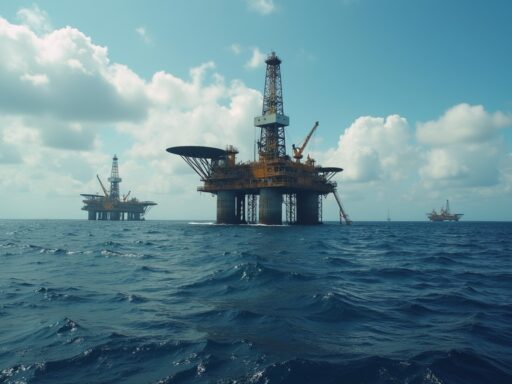
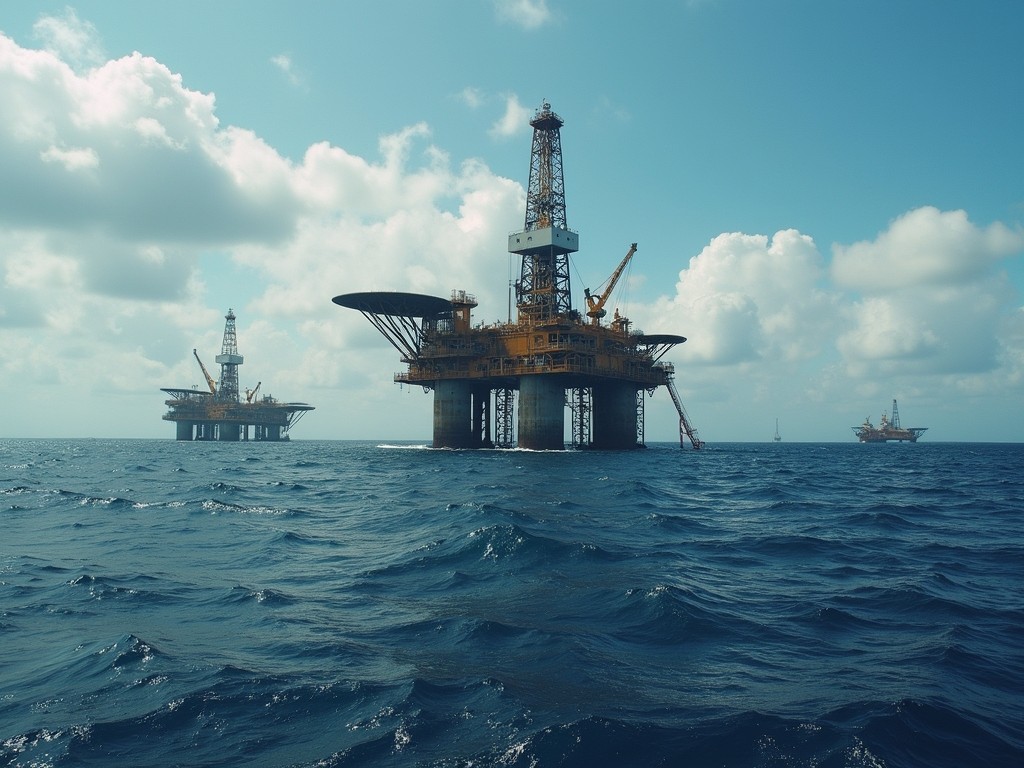
 “West Africa is probably the most dynamic offshore play in the world today.” – Offshore Magazine
There is a huge new boom in oil exploration throughout Central Africa. Following the end of the cold war rivalries in the region and the development of new technologies in the last decade, oil companies are falling over themselves to offer lucrative contracts to governments in Cameroon, Chad, the Congo, Equatorial Guinea, Gabon, and Angola.
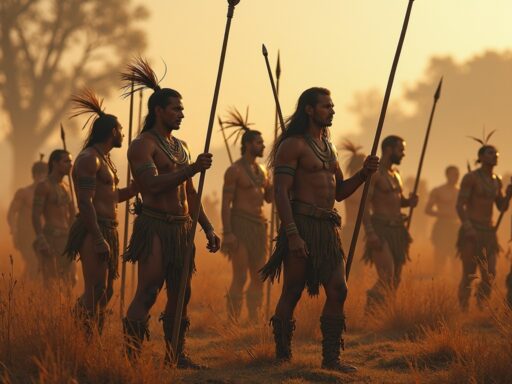
The World Bank plans to fund an oil pipeline through Central African rainforests that will bring huge profits to Shell, Exxon, and Elf while causing environmental havoc and threatening local populations – all with U.S. taxpayers backing the deal. The oil companies are about to build a 600-mile pipeline from the Doba oil fields in Chad to coastal Cameroon, slashing through fragile rainforest that is home to the Baka and Bakola peoples, communities of traditional hunter-gatherers.
Oil industry experts say the pipeline could deliver between 150,000 and 250,000 barrels per day from the Kom, Miandoum, Bolobo and Sdigui fields. “Once construction begins, we’ll see an uncontrollable influx of people in search of work – the result will be deforestation, wildlife poaching, and the loss of community land,” says Environmental Defense Fund economist Korinna Horta.
Observers fear that the project will create another Ogoniland, the Nigerian region devastated by decades of oil extraction and brutal military rule. Shell has worked with Nigeria’s dictatorship to crush non-violent environmental organizing among the Ogoni, who have watched more than 2,000 of their people killed during the last five years.
In Chad, the pipeline is already escalating current conflicts. In March 1998, one hundred unarmed civilians were massacred by security forces in the oil-producing region in the Doba basin in southern Chad, according to an Amnesty International report. It was the second such massacre in less than a year, an increase in political violence that many believe is directly related to new oil exploration plans.
These situations are of particular concern because both Chad and Cameroon have records of violence against government critics, according the U.S. State Department.
The arrival of the oil companies has escalated the violence in the region. About four years ago Dingamtolem Ajikolmian, a local peasant, heard that an airplane was to land on a nearby field, and he decided to take his children to witness the rare event. Nervous Chadian security forces protecting Exxon staff shot and killed Ajikolmian in front of his children, according to volunteers from Germany who lived in the Doba region for several years.
In Cameroon, local environmental activists have spoken out against the project. Jean Nke Ndih, president of Defense de l’Environnement Camerounais (DEC) says that the pipeline will only serve to further impoverish the people of the two countries and benefit “highly corrupt regimes” in the two capital cities of Yaounde and N’djamen. Activists in Chad, on the other hand, have to be more careful. For example, few Chadians dare to talk publicly about the family of President Idriss Daby, which controls the local oil industry, because such an action could land the speaker in jail.
Environmental worries around the pipeline have not been addressed either. A project Environmental Impact Assessment, commissioned by Exxon and published late last year, was criticized by the official Dutch Commission on Environmental Impact Assessment, which stated that: “The Commission concludes that essential information is lacking in the EIA. On the basis of the EIA neither the project nor its environmental consequences can fully be overseen.” The assessment does not identify the ecosystems that would potentially be impacted, nor does it explain the possible impact on the Baka and Bakola peoples through whose forests the pipeline would pass. Nor does the assessment include an oil spill response plan or provisions for a fund to pay liability for damages (including natural resource damages) in case of an accidental oil spill.
Even as the World Bank concedes that Cameroon has mismanaged its finances and is facing environmental degradation, it is still rushing head-first toward funding the pipeline, following in the footsteps of other mega-projects that have helped fuel the destruction of 92 percent of Cameroon’s original frontier forests.
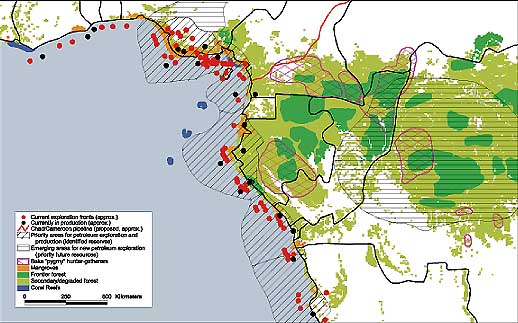
The so-called “pygmy” peoples – the Baka and Bakola – and their home, may face an even more serious, long-term threat. One of Africa’s most promising untapped petroleum basins lies under the majority of their homeland, deep in the Congo basin, under Africa’s last intact frontier rainforest ecosystem (see map). New exploration in this area would be devastating.
Meanwhile, the oil boom in Africa rolls on. “Every night, the horizon south of Equatorial Guinea’s tiny capital, Malabo, is illuminated by an orange smudge as gas from the offshore Alba field is burnt off. Seven years ago, there was no flare, no gas and no oil. Equatorial Guinea, in the crescent of Africa’s most fertile hydrocarbons prospect, was desperately poor, with a shabby reputation for tyranny and corruption,” wrote a visiting British journalist earlier this summer.
Things haven’t changed much, he adds. “Thus far, the tangible benefits for Equatorial Guinea of the oil boom have been few and ill-distributed, fueling social tensions that the governments says it lacks the resources to combat. Most rural areas continue to do without electricity or running water and there has been a surge in ethnic tension and violence. Each year, the United Nations lists a litany of human rights abuses, while opposition activists complain that a mask of multiparty democracy disguises an old- fashioned dictatorship.”